

24 Jun What Is Paint Correction? Understanding What It Can and Cannot Fix
What Is Paint Correction? Understanding What It Can and Cannot Fix
Paint correction is one of the most common services customers ask about, but it is also one of the most misunderstood.
At Tri Cities Detail, we often have people contact us asking for paint correction when they actually need auto body repair, touch-up paint, dent repair, or rock chip repair. We also see confusion in the detailing industry when some detailers describe services like clay bar treatment as a “step” of paint correction.
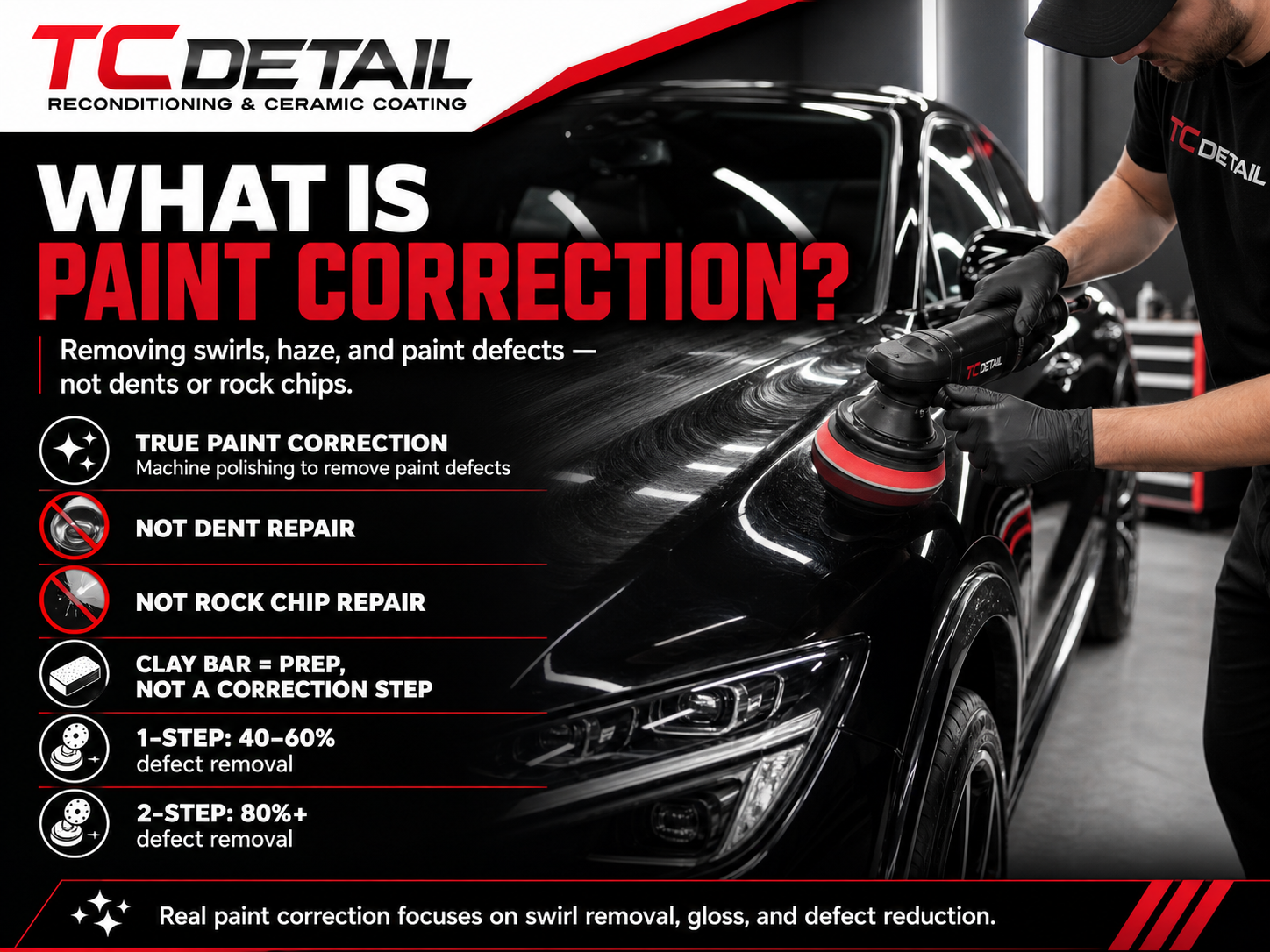
The truth is simple: paint correction is the process of removing or reducing defects in the paint through machine polishing.
It is not dent repair.
It is not repainting.
It is not rock chip repair.
It is not clay bar treatment.
Paint correction is about improving the painted surface by removing defects like swirl marks, haze, oxidation, light scratches, and wash marring.
What Paint Correction Actually Means
Paint correction is a polishing process that removes a very thin layer of clear coat to level the surface and reduce visible defects.
Most modern vehicles have a clear coat layer over the paint. Over time, that clear coat can develop defects from washing, drying, automatic car washes, road grime, dust, poor maintenance, and improper detailing methods.
Common paint defects include:
- Swirl marks
- Light scratches
- Wash marring
- Haze
- Oxidation
- Water spot etching
- Towel marks
- Buffer trails
- Light surface defects
Paint correction uses compounds, polishes, pads, and polishing machines to safely refine the surface and restore clarity, gloss, and depth.
Paint Correction Is Not Dent Repair
A dent is a physical change in the shape of the panel. Paint correction cannot remove dents.
If your vehicle has a dent, that falls under paintless dent repair or auto body repair, depending on the damage.
Paint correction can improve the paint around a dent if that area has swirls or scratches, but it will not reshape the metal or plastic panel.
So if someone says they need a “paint correction” for a dent, they likely need dent repair, not detailing.
Paint Correction Is Not Rock Chip Repair
Rock chips are also different from paint correction.
A rock chip is a missing piece of paint caused by impact from gravel or road debris. Since paint is physically missing, polishing cannot bring it back.
Paint correction can improve gloss and remove defects around the area, but it cannot fill in missing paint.
Rock chips usually require:
- Touch-up paint
- Paint chip repair
- Refinishing
- Auto body work
- Paint protection film to prevent future damage
This is an important distinction. Paint correction improves existing paint. It does not replace paint that has been chipped away.
Paint Correction Is Not Auto Body Work
Auto body work involves repairing physical damage to the vehicle. That can include dents, cracked bumpers, deep scratches through the paint, collision damage, panel repair, sanding, priming, repainting, and refinishing.
Paint correction is a detailing service. It improves defects in the clear coat through polishing.
If damage is too deep, through the clear coat, or into the base coat or primer, it usually cannot be safely corrected with polishing alone.
A good detailer should be honest about what can be corrected and what requires body shop repair.
Clay Bar Is Not Paint Correction
This is another major misunderstanding.
A clay bar treatment is a paint decontamination process. It removes bonded contaminants from the surface of the paint, such as rail dust, overspray, industrial fallout, and embedded grime.
Clay bar treatment makes the paint feel smooth, but it does not remove swirl marks or correct paint defects.
Clay bar is an important prep step before polishing, but it should not be counted as a step of paint correction.
For example, if a detailer says they performed a “3-step paint correction” and they are counting washing or clay bar as one of those correction steps, that is misleading.
A true paint correction step involves machine polishing or compounding the paint.
What Is a One-Step Paint Correction?
A one-step paint correction is usually a single polishing process designed to improve gloss and remove a moderate amount of paint defects.
This service is ideal for vehicles that need a noticeable improvement but do not require heavy defect removal.
A one-step correction typically removes or reduces around 40–60% of visible paint defects, depending on the paint condition, paint hardness, defect depth, pad and polish choice, and overall vehicle condition.
A one-step correction can improve:
- Gloss
- Clarity
- Light swirls
- Minor haze
- Light wash marring
- Overall paint appearance
A one-step correction is a great option for daily drivers, vehicles being prepared for protection, or customers who want a cleaner, glossier finish without chasing every defect.
What Is a Two-Step Paint Correction?
A two-step paint correction is a more advanced polishing process.
It usually includes a cutting or compounding step first to remove deeper defects, followed by a finishing polish to refine the paint and increase gloss.
A two-step correction typically achieves 80% or more defect removal, depending on the condition of the paint and what can be safely corrected.
A two-step correction is better for vehicles with:
- Heavier swirl marks
- More noticeable scratches
- Deeper wash marring
- Haze or oxidation
- Poor previous polishing work
- Paint that needs a higher level of refinement
This service takes more time, more skill, and more product than a one-step correction. That is why it costs more.
Why Paint Correction Is Not Always 100%
Many customers assume paint correction means every scratch or defect will disappear. That is not always realistic or safe.
Paint correction removes a small amount of clear coat. Since the clear coat is limited, the goal is to improve the paint while preserving long-term durability.
Some defects may be too deep to remove safely. If a scratch catches your fingernail, it may be too deep for full correction.
A professional detailer should never chase defects so aggressively that they risk burning through the clear coat or compromising the paint.
The goal is safe improvement, not reckless removal.
Why Proper Inspection Matters
Before paint correction, the vehicle should be inspected carefully.
A proper inspection helps determine:
- The type of defects present
- How deep the defects are
- Whether the paint is original or repainted
- Whether correction is safe
- What level of correction is realistic
- Whether a one-step or two-step correction is needed
- Whether some damage requires body shop repair instead
This is why paint correction pricing can vary. Not every vehicle needs the same level of work, and not every defect can be corrected the same way.
Paint Correction and Ceramic Coating
Paint correction is often recommended before ceramic coating because a coating locks in the condition of the paint.
If you apply ceramic coating over swirls, haze, or oxidation, those defects will still be visible underneath the coating.
Correcting the paint first improves gloss, clarity, and overall appearance before protection is installed.
At Tri Cities Detail, we want the paint properly prepared before protection is applied. That way, the vehicle looks better and the coating has a cleaner surface to bond to.
Honest Paint Correction Expectations
At Tri Cities Detail, we believe in being honest about what paint correction can and cannot do.
Paint correction can remove or reduce swirl marks, haze, oxidation, wash marring, and many light scratches.
Paint correction cannot properly fix dents, missing paint, rock chips, deep gouges, cracked paint, or collision damage.
Those issues require different repair methods.
Our goal is to explain the difference clearly so customers know what service they actually need and what results they can realistically expect.
Is Paint Correction Worth It?
Paint correction is worth it if you want to restore gloss, improve clarity, remove swirls, and make your paint look dramatically better.
It is especially valuable if:
- Your paint looks dull
- Your vehicle has swirl marks
- You see scratches in direct sunlight
- Your paint has haze or oxidation
- You are preparing for ceramic coating
- You want your vehicle to look cleaner and glossier
- You want professional results instead of a temporary shine
For many vehicles, paint correction can make the paint look years newer when performed correctly.
Professional Paint Correction in the Tri-Cities
If you are looking for paint correction in the Tri-Cities, make sure you are comparing the actual process, not just the name of the service.
A true paint correction service should involve machine polishing to remove or reduce paint defects. Clay bar treatment, washing, and decontamination may be part of the preparation process, but they are not correction steps.
At Tri Cities Detail, we focus on real paint correction, honest expectations, and safe defect removal. Whether your vehicle needs a one-step polish for gloss enhancement or a two-step correction for heavier defect removal, we can help you understand the right option for your paint.
Contact Tri Cities Detail today to schedule a paint inspection and learn which paint correction service is right for your vehicle.
Sorry, the comment form is closed at this time.